Managing Noise and Preventing Hearing Loss
Noise as a Hazard
Excessive noise exposure causes permanent, irreversible hearing loss. Construction work involves many noise-producing activities making hearing protection essential.
Common Construction Noise Sources:
- Power tools (grinders, saws, nail guns, jackhammers)
- Heavy plant and equipment (excavators, loaders, compactors)
- Concrete cutting and drilling
- Impact tools (jackhammers, post drivers)
- Generators and compressors
Noise-induced hearing loss is permanent and cannot be reversed. Prevention is the only solution.
Exposure Standards
WHS Regulation 56:
- LAeq,8h = 85 dB(A) (8-hour time-weighted average)
- LC,peak = 140 dB(C) (peak noise level)
What this means:
- Average noise over 8 hours must not exceed 85 dB(A)
- Instantaneous peak noise must not exceed 140 dB(C)
Indicative Noise Levels:
- Normal conversation: 60 dB(A)
- Busy traffic: 80 dB(A)
- Lawn mower: 90 dB(A)
- Chainsaw: 110 dB(A)
- Jackhammer: 120 dB(A)
If you need to raise your voice to talk to someone 1 meter away, noise levels are likely approaching or exceeding 85 dB(A).
Who Has Duties?
PCBUs
Must:
- Identify noise hazards
- Assess risks of hearing damage
- Eliminate or minimize noise exposure
- Ensure exposure below standards
- Provide hearing protectors if engineering controls insufficient
- Provide information and training
- Conduct audiometric testing where required
Designers, Manufacturers, Suppliers
Must:
- Design plant to minimize noise generation
- Provide noise emission data
- Include noise control features in equipment
Risk Management Process
1. Identify Hazards
Indicators of Noise Hazard:
- Need to shout to be heard 1 meter away
- Ringing ears or muffled hearing after work
- Complaints from workers about noise
- Noise complaints from neighbors/public
Review:
- Manufacturer specifications for equipment (noise ratings)
- Previous noise assessments
- Incident reports
2. Assess Risks
When Noise Assessment Required:
- Uncertain if exposure exceeds standards
- To verify control effectiveness
- After changes to work processes or equipment
Who Conducts Assessment:
- Competent person (occupational hygienist, acoustician)
- Uses calibrated sound level meters
- Personal noise dosimeters for individual exposure
3. Control Risks: Hierarchy of Control
Level 1: Elimination
- Modify process to not require noisy equipment
- Example: Use mechanical fixing instead of impact tools where possible
Level 2: Substitution
- Replace with quieter equipment or methods
- Example: Electric tools instead of pneumatic tools
- Example: Hydraulic splitters instead of jackhammers
Level 2: Isolation
- Separate workers from noise source
- Relocate noisy equipment away from workers
- Establish noise exclusion zones
- Remote operation of noisy plant
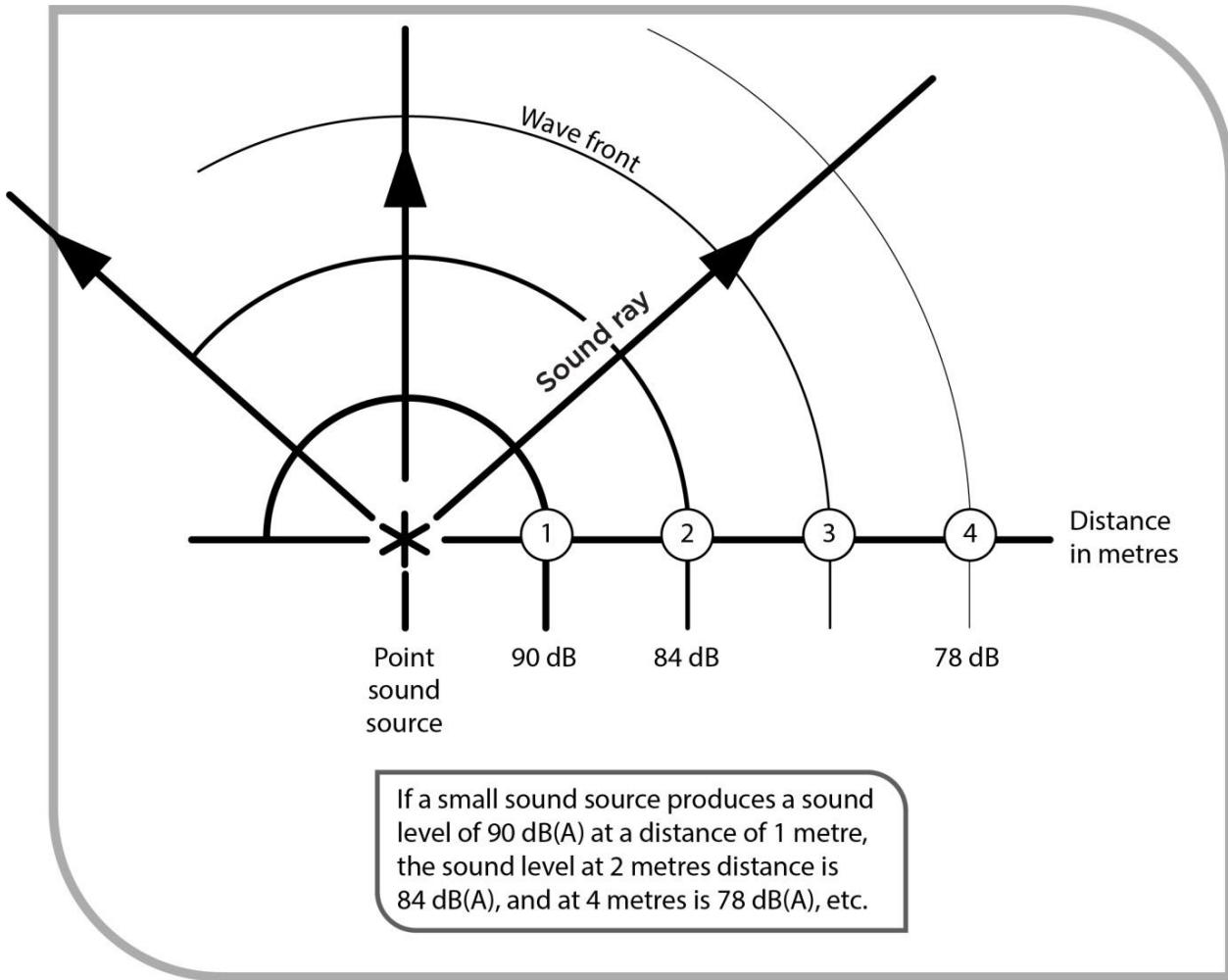 Figure: Sound is reduced by about 6 dB for each doubling of distance
Level 2: Engineering Controls
Noise Reduction at Source:
- Install mufflers on exhaust systems
- Use damping materials on vibrating surfaces
- Maintain equipment (worn parts increase noise)
- Enclose noisy equipment in acoustic barriers
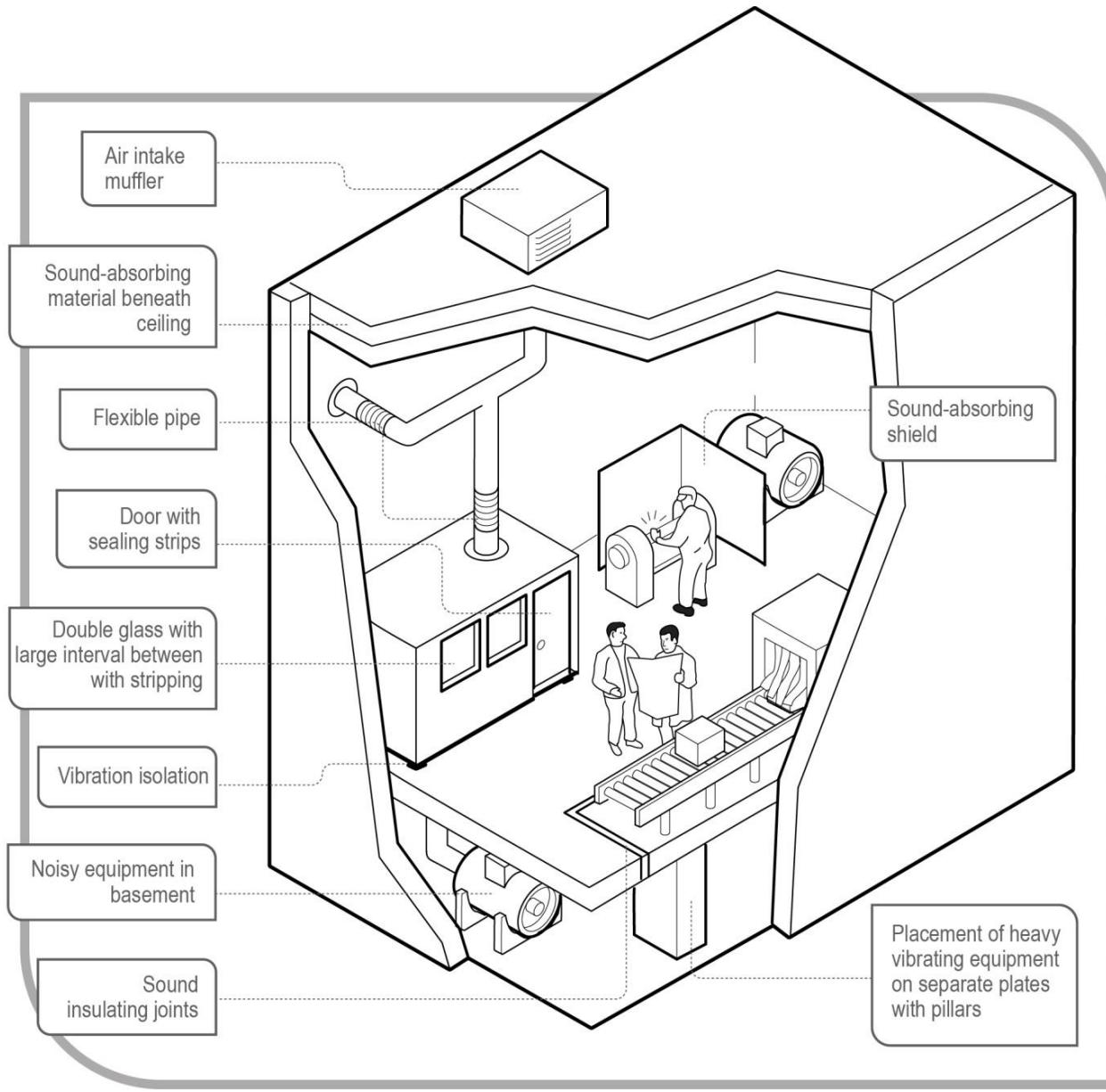 Figure: Examples of noise control measures (enclosures, isolation)
Example: Fit compressor with acoustic enclosure and muffled exhaust.
Barriers and Screens:
- Acoustic barriers between noise source and workers
- Sound-absorbing materials in enclosed spaces
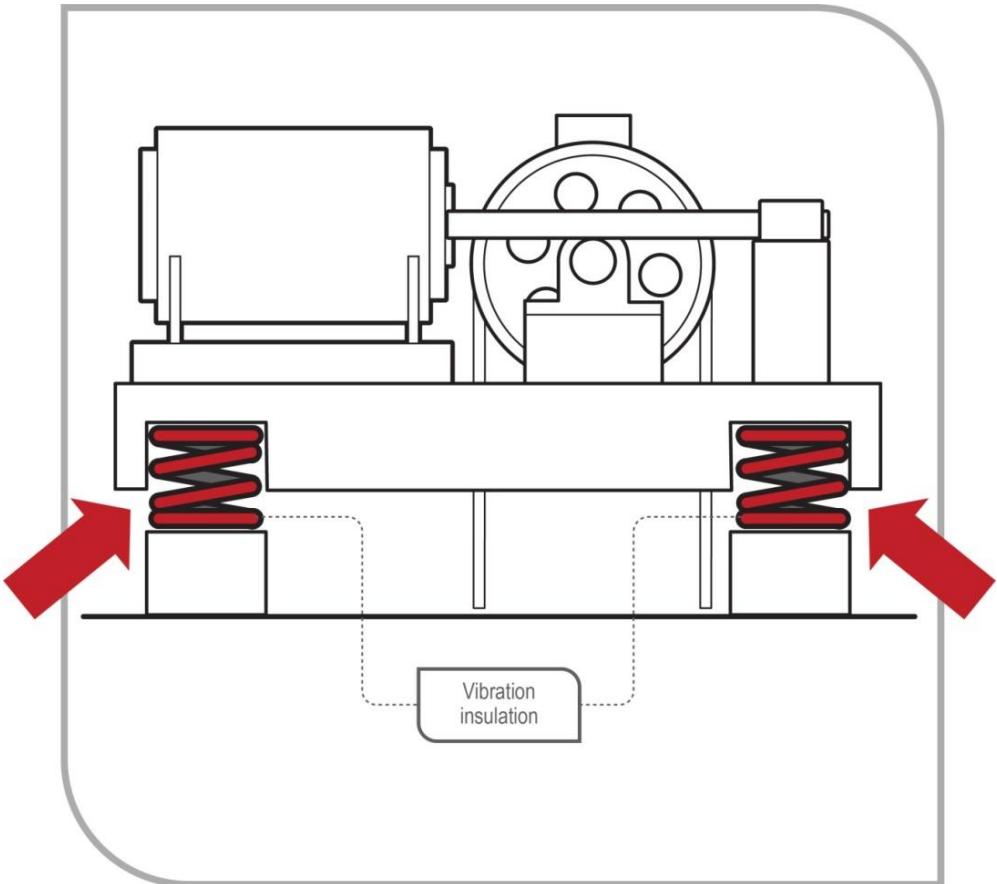 Figure: Isolating machine vibration from structure
Maintenance:
- Regular maintenance reduces noise (worn bearings, loose parts)
- Replace damaged mufflers and acoustic seals
Level 3: Administrative Controls
- Limit time workers exposed to high noise
- Job rotation to reduce individual exposure
- Restrict access to high-noise areas
- Schedule noisy work when fewer workers present
Level 3: Personal Protective Equipment
Hearing protection is least effective control. Use only after higher controls implemented.
Types of Hearing Protection:
Earplugs:
- Foam, pre-molded, or custom-fitted
- Inserted into ear canal
- Typical reduction: 20-30 dB
Earmuffs:
- Cushioned cups over ears
- Typical reduction: 20-35 dB
- More visible (easier to check compliance)
Selection:
- Must provide sufficient attenuation to reduce noise below 85 dB(A)
- Consider comfort (workers more likely to wear)
- Hygiene (clean, replace when worn)
Limitations:
- Only effective when worn correctly and consistently
- Gaps or poor fit reduce effectiveness dramatically
- Workers may remove during breaks but still in noisy area
4. Maintain and Review
- Inspect and maintain noise control equipment
- Monitor noise levels after changes
- Check hearing protector condition
- Review after workers report hearing issues
- Conduct audiometric testing
Audiometric Testing
When Required (WHS Reg 58): If worker exposed to noise exceeding standards and at risk of hearing loss.
What it Involves:
- Baseline hearing test (before exposure)
- Periodic re-testing (annually for high-risk, every 2 years otherwise)
- Conducted by qualified person (audiologist, audiometrist)
- Identifies early signs of hearing loss
Benefits:
- Detects hearing loss early
- Allows intervention before significant damage
- Confirms control measures working
Worker Rights:
- Access to test results
- Confidential health information
- No cost to worker
Practical Construction Example
Scenario: Concrete cutting for service trenches
Hazard Identification
- Petrol-powered concrete saw generates 110 dB(A)
- Workers cutting for several hours per day
- Other workers in vicinity
Risk Assessment
- High risk: Exposure well above 85 dB(A)
- Operator and nearby workers affected
Controls Implemented
Engineering:
- Selected electric saw (quieter than petrol, 95 dB(A))
- Acoustic barrier erected around cutting area
- Work during day (fewer workers on site)
Isolation:
- Exclusion zone 5 meters from saw
- Only operator and one offsider in zone
- Signage indicating high-noise area
Administrative:
- Limit continuous cutting to 1-hour blocks
- Job rotation among qualified operators
- Advance notice to other trades (relocate if possible)
PPE:
- Class 5 earmuffs for operator (30 dB reduction)
- Earplugs for offsider (25 dB reduction)
- Hearing protection mandatory in exclusion zone
Monitoring
- Noise assessment confirmed exposure <85 dB(A) with controls
- Audiometric testing arranged for regular operators
Other Noise Effects
Ototoxic Substances
Exposure to certain chemicals (ototoxic substances) can result in hearing loss or exacerbate the effects of noise.
- Solvents: Toluene, xylene, styrene
- Heavy Metals: Lead, mercury
- Asphyxiants: Carbon monoxide
Control measures must consider both noise and chemical exposure.
Tinnitus
Ringing, buzzing, or whistling in ears. May be temporary or permanent.
Communication and Safety
High noise:
- Impairs communication
- Prevents hearing warning signals
- Masks approaching vehicles/equipment
- Increases accident risk
Controls:
- Visual warning signals in high-noise areas
- Hand signals for communication
- Flashing lights on mobile plant
Stress and Fatigue
Prolonged noise exposure causes:
- Increased stress levels
- Mental fatigue
- Reduced concentration
- Lower productivity
Information and Training
Workers must be informed about:
- Risks of noise exposure and hearing loss
- Noise levels in their work areas
- How to use and maintain hearing protection
- How to identify when noise controls not working
- Audiometric testing requirements
- Reporting hearing changes